

The confirmation of Tottenham’s survival in the Premier League on the final game of the 25/26 season caused mixed reactions depending on club allegiances. Arsenal fans will have felt slightly disappointed that their best case scenario didn’t play out (although most of them are happy enough with their league title), and West Ham fans will now have to prepare for life in the Championship. Spurs fans will be able to relax, now that they’ve dodged what could have been a catastrophic relegation with major implications both on and off the field. But, most importantly for this article, the real beneficiaries will be those clubs interested in West Ham’s players – none more so than Mateus Fernandes.
The 21-year-old Portuguese midfielder has been the subject of several interest from bigger clubs such as Manchester United and Real Madrid following an impressive debut season for West Ham. This has followed a strong spell at Southampton, a club at which he only spent a season after joining from Sporting in the summer of 2024 for 15 million Euros. Despite only playing in England for two seasons, Fernandes has acclimatised well to the physical demands of the Premier League, allowing his technical qualities to shine.
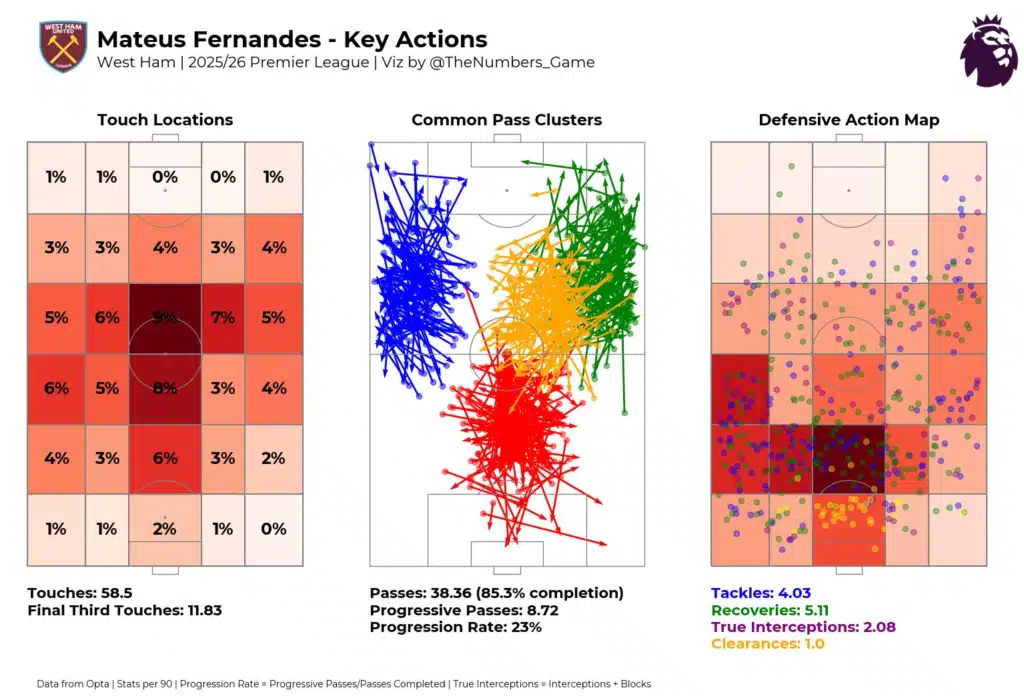
At Southampton, Mateus Fernandes played predominantly as an attacking midfielder. However, his time at West Ham has seen him deployed further up the field, both centrally and on the left, as well as further back, as far as defensive midfielder. His main position has been as a central midfielder, as part of a 2-man midfield under Nuno Espirito Santo. In this midfield role, Fernandes has been able to stamp his authority on the game in possession, with his touch locations spanning the full width of the central third of the pitch as well as the middle of both the defensive and attacking thirds. His most common passing clusters being spread out across the pitch reflect both his large locus of activity as a midfielder as well as his positional versatility, with his leftmost cluster being representative of his time spent playing on the left-wing.
Off the ball, Fernandes is all-action, with his defensive action map showing tackles, recoveries and interceptions in all thirds of the pitch. With West Ham being a deeper side, settling into lower blocks out of possession, a large quantity of his defensive actions took place just outside of the defensive penalty area, but the appearance of actions further up imply a healthy appetite for winning the ball back in earlier phases of defensive play.
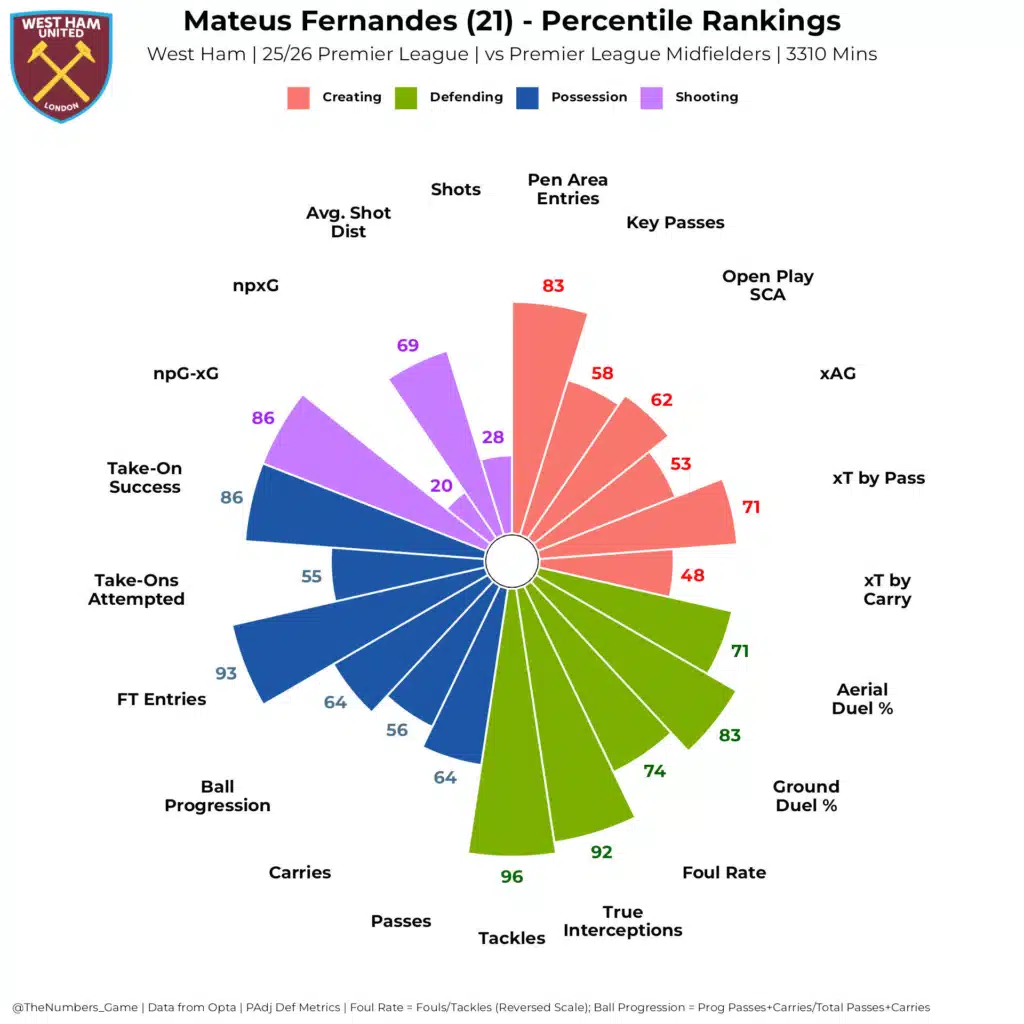
Being a roaming player such as Fernandes is only a real benefit if his ability on the ball warrants it. Luckily, his numbers across the 25/26 season prove his worth. On the ball, a high percentile ranking against Premier League midfielders for final third entries (93) and penalty box entries (83) represents his high intent to get the ball forward in several phases of attack. We’ll look at his passing specifically later, but his take-on success ranking (86) shows that he’s reliable at keeping the ball when carrying. His expected threat by carry is at the 48th percentile, suggesting that his carries don’t necessarily move him into the most dangerous positions, but we can still see that Fernandes is a player that can be trusted to move the ball forward to enable attacks.
Whilst his finishing is good, shown by an 86th percentile ranking for npG-xG, his low volume of shots (28th percentile) and high average shot distance (69th percentile) mean that it would be naive to suggest that Fernandes should shoot more when on the ball.
Off the ball, we can prove that Mateus Fernandes’ high defensive volume isn’t just a function of West Ham’s defensive play style. Ranking in above the 90th percentile for both tackles (96) and true interceptions (92) after adjusting for team possession shows that Fernandes’ aggression out of possession is to his own credit rather than the team’s.
He also has the quality to back up his volume, with a near-elite ranking for ground (83) and aerial duel success (71). His lower-than-average number of fouls per tackle (74th percentile, reversed scale) also suggests that he’s quite safe when putting in tackles around the pitch. Again, Fernandes’ numbers show him to be a player that can be trusted to contribute a high volume of actions around the pitch at a relatively low risk.
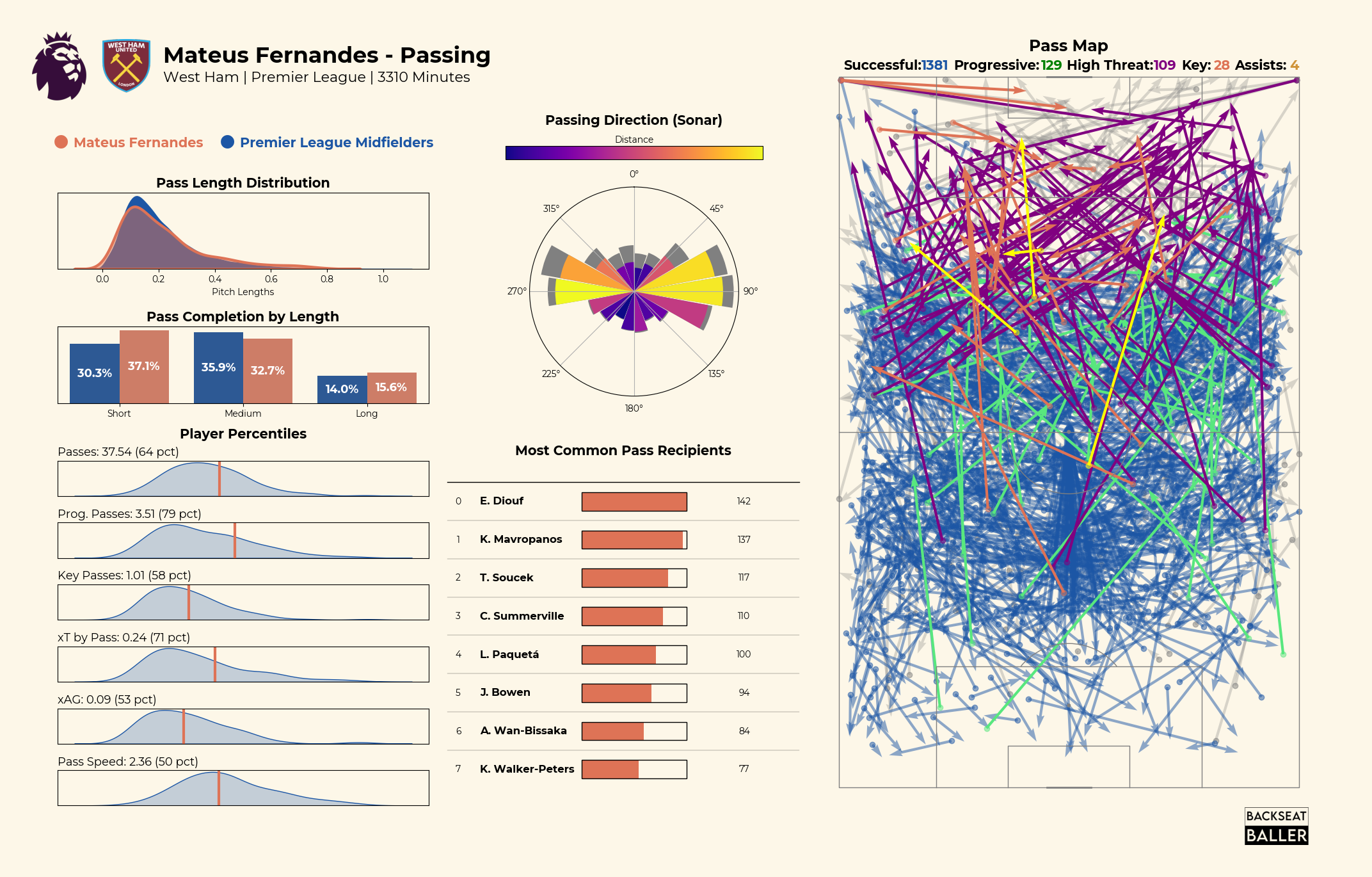
Arguably the main technical quality that Mateus Fernandes possesses is his passing. The above passing dashboard highlights his tendencies and qualities in six different visualisations that represent different angles of measurement.
Looking first at his passing length, his passing distribution is flatter compared to the average Premier League midfielder, suggesting that Fernandes makes passes of a wider range of lengths. A quick glance at his pass map over the season backs this claim up, with a clear view of shorter passes in the defensive penalty area and longer switches further up from the flanks. Those switch passes often accumulate a large amount of threat, and it’s his longer passes that lead to shots.
However, the peak of his passing length distribution sits further left compared to the average midfielder, suggesting that Fernandes does tend to make shorter passes. This is in tune with his quality making short passes, shown by his pass completion by length. A 37.1% pass accuracy for short passes per-90 sits well above that of an average midfielder (30.3%), and his long pass accuracy is also above average (15.6% vs 14.0%). It is worth noting that his passes over medium lengths sits below average (32.7% vs 35.9%).
Moving down on the dashboard, we can highlight Fernandes’ relative performance over a few more passing metrics. Sitting in the 67th percentile for passes per 90 reiterates his willingness to get on the ball, and high rankings for progressive passes (79) and expected threat by pass (73) are examples of his attacking-mindedness when he is on the ball. His key pass (59) and expected assists (56) numbers aren’t outliers by any means – he tends not to make the final pass, but the ones that precede it. He sits right in the middle of the pack for pass speed, neither rushing nor dragging the tempo of the game when looking to make a pass.
The majority of Mateus Fernandes’ passes are lateral, shown by his directional pass sonar. This by itself isn’t surprising, but his lack of a strong directional bias – he attempts passes to his right and his left a roughly equal amount, with a similar pass completion (note that the grey sections of each slice represent unsuccessful passes) – is useful for a team that wishes to attack from multiple channels. This quality facilitates unpredictability in attack.
The most common recipient of Fernandes’ passes is El Hadji Malick Diouf at left back. Diouf (another player who may be on the radar of clubs following relegation) is a fullback who likes to get forward to aid in chance creation, alongside the winger in front of him, Crysencio Summerville, who is also a major beneficiary of Fernandes’ passes. Mavropanos and Soucek are players largely in the midfielder’s short range orbit, and Lucas Paqueta acted as a forward outlet for West Ham before his January departure.
Fernandes’ importance to the team through his passes cannot be understated. He was responsible for 11.6% of his team’s passes in the 25/26 season, ranking him 6th for across Premier League midfielders. This is a metric whose leaders consist of Elliot Anderson, James Garner and Declan Rice, so he’s in good company.
Summing up what the dashboard shows us, we can see that in both buildup and chance creation, Fernandes’ passing is key to West Ham’s attack. His versatility and volume of passing across ranges and directions combined with his safety on the ball through high short pass completion makes him a valuable centroid for passing networks.
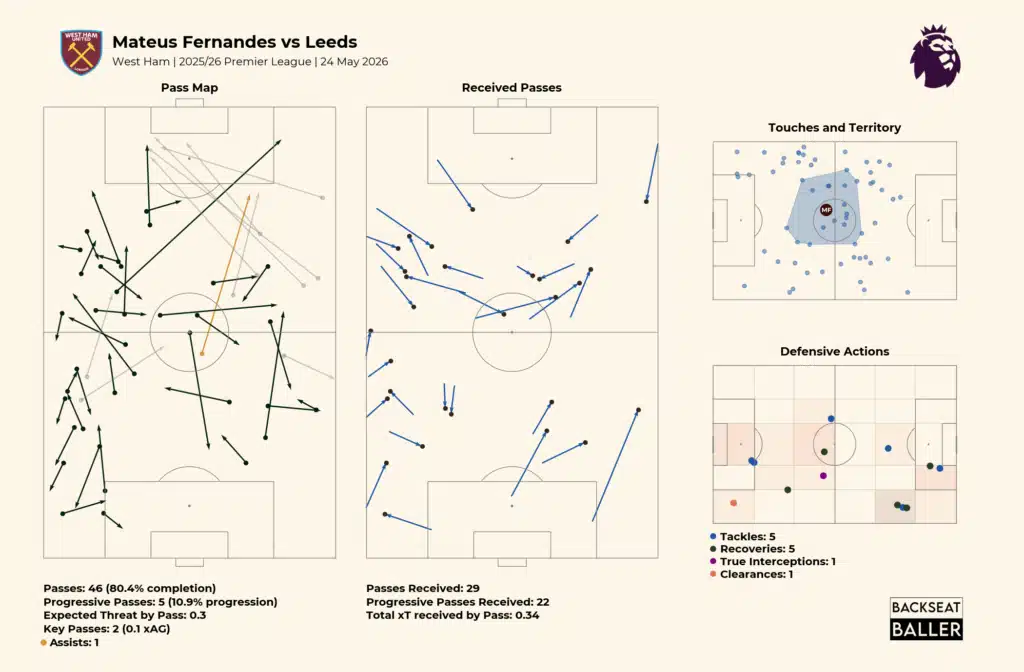
Putting this all together in a match scenario, West Ham’s final league fixture against Leeds was a good showcase of Mateus Fernandes’ strengths. His touches, passes, and defensive actions spanned the length of the pitch. We can see his high pass completion for shorter passes and passes within the defensive half of the pitch, as well as his longer passes in the opponent’s half, with his assist for Jarod Bowen a prime example of his ability to send a ball into space for a runner to get onto.

Fernandes has a market value of around £45 million according to transfermarkt. However, recent reports have suggested that West Ham are looking to demand closer to £80 million to secure the Portuguese midfielder. It’s a contentious asking price for a player who, without a transfer, faces Championship football next season, and for a team who, with large stadium running costs and team wages, most likely need to sell to ensure financial stability.
If Mateus Fernandes does end up leaving for West Ham’s asking price, it will definitely lead to questions about overpayment. However, what’s been shown here is a player who is already playing at a level well above his age suggests, in a league that often takes several years to fully get accustomed to. Wherever he goes, Fernandes represents a future-proof and very sensible signing for any team. Perhaps, in a few years’ time, £80 million for Fernandes might be seen as a bargain.